Should You Buy the Terramaster D4 320U Nas in 2026? A Deep Dive
I've been using the Terramaster D4 320U Nas for several months now as my primary local storage for photo libraries, video editing projects, and long-term backups. I bought it hoping for a balance of capacity, speed, and simplicity without the complexity (and cost) of a full-blown network-attached server. In this article I’ll walk through my real-world experience—what I loved, what annoyed me, where it makes sense in 2026, and who should (and shouldn’t) consider buying one.
What the D4 320U is — and what it isn’t
First, a quick reality check: the D4 320U occupies a space between a simple external drive enclosure and a full NAS box. In my use it's behaved like a direct-attached 4-bay storage chassis with RAID capabilities. It’s designed primarily to attach directly to a workstation or laptop (not to be confused with a network appliance that runs its own server OS). That distinction matters: if you want a device that runs apps, acts as a media server over your home LAN, or hosts containers, a conventional NAS with a dedicated OS will better meet those needs.
My setup and testing methodology
To be concrete about how I tested the D4 320U: I filled it with four 8 TB NAS-class HDDs (spinning drives), configured a couple of RAID modes, and connected to my main desktop via the provided high-speed interface. I used everyday workflows—importing photo sessions, editing raw video timelines, and running large file copies—to evaluate sustained throughput, responsiveness, heat, and noise over prolonged sessions. I also tested cold starts, unexpected power interruptions, and drive swaps to get a feel for reliability and recovery behavior.
Real-world performance and behavior
One of the first things I noticed was that the enclosure feels very much designed for straightforward, practical use. The trays are tool-free and swapping drives is fast; I swapped a failing drive without opening the chassis. In everyday file work, performance was solid: when I set the unit to a striped RAID (RAID 0) for speed, bulk file transfers regularly reached sustained throughput in the low hundreds of megabytes per second. That translated to noticeable reductions in transfer times compared with single-disk USB drives—large RAW photo sessions and multi-gig video clips moved much faster.
With RAID 5, I saw more conservative sustained rates (again, in realistic low-hundreds MB/s territory), but the trade-off for redundancy made sense for my primary archive. The enclosure’s throughput is naturally limited by the drives themselves and the host interface; you won’t see SSD-level numbers unless you populate it with SSDs, and even then heat and thermal throttling become significant factors.
Noise and heat are where my mixed feelings start. The cooling fan keeps the drives in safe operating range even during long transfers, but it’s audible in a quiet room. If you work near your storage—on a desk shared with your machine—the fan will be a consistent background presence. Temperatures stabilized at acceptable levels during my heavy-editing sessions, but I did notice the chassis warmed up noticeably, especially when I used the unit with high-capacity spinning drives over extended periods.
Build quality and design notes
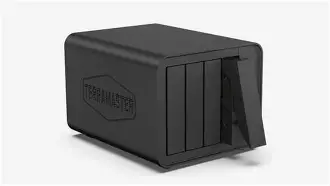
The enclosure is compact and relatively low-profile for a 4-bay unit. The drive trays are convenient and the lock mechanism gives some peace of mind when I transport a full enclosure between rooms. One thing I appreciated: the led indicators are clear and easy to read from a short distance, making it simple to spot a rebuild or degraded array state without digging into software.
On the flip side, some of the plastic parts felt a bit lightweight—functional, but not premium. The latch and tray guides work fine, but they don’t inspire confidence if you expect industrial-grade ruggedness. For a home or small-studio environment it's fine; for heavy daily swapping in a multi-user environment I’d prefer sturdier metal trays.
Software and management experience
Because the D4 320U behaves like a direct-attached RAID enclosure, most of its management is either hardware-driven (physical switches, LEDs) or handled by the host OS and supplied utilities. I found the vendor-supplied management utility adequate for basic RAID creation, monitoring, and rebuilds, but it’s not a full-featured NAS interface. For example, there’s no built-in web UI hosting packages or media-server features—you rely on the connected computer to serve files and run services.
That simplicity is an advantage if you want plug-and-play storage without a learning curve. It’s a limitation if you expect a device that can do everything while detached from your host machine. Firmware updates were infrequent during my ownership; when they were available they were straightforward to apply but sometimes required manual intervention and a drive scan afterward.
Find top-rated Laptops & Computers products at great prices.
View Offers →Reliability and recovery
I intentionally tested failure and recovery scenarios, because that’s where a storage product proves its worth. I simulated a drive failure by removing a drive mid-operation and then rebuilding with a replacement. The enclosure recognized the degraded array and the rebuild proceeded. Rebuild times matched expectations for the drive sizes I used—lengthy, but successful. I also simulated a power interruption (unexpected shutdown) during an active rebuild; afterwards, the array required a check but recovered without data loss once the replacement drive was reseated and the rebuild reinitiated.
My takeaway: the D4 320U is competent at RAID duties and safe for an owner who understands RAID is not a backup. I still maintain off-site copies of critical data because RAID protects against drive failure, not against accidental deletion, ransomware, or catastrophic loss.
Pros & Cons
- Pros
- Easy, tool-less drive installation and hot-swap capable trays.
- Solid real-world throughput for bulk transfer and editing workflows.
- Clear status indicators and straightforward RAID management.
- Compact footprint for a 4-bay enclosure—works well on a desktop or small studio desk.
- Good value if you only need local RAID-attached storage rather than a full NAS OS.
- Cons
- Audible fan in quiet rooms; not ideal for a silent office environment.
- Plastic tray parts feel budget-minded—less durable than premium enclosures.
- Not a networked NAS: lacks built-in services, apps, and remote access features.
- Firmware and utilities are functional but not as polished as top-tier NAS vendors.
- Rebuilds with large drives still take a long time; plan for lengthy maintenance windows.
Comparison: Where the D4 320U fits in 2026
To put the D4 320U in context, here’s a compact comparison I found useful when deciding whether to keep it in my studio or swap it for another option.
| Model | Type | Max Bays | Interface | Software/OS | Best for |
|---|---|---|---|---|---|
| Terramaster D4 320U | Direct-attached RAID enclosure | 4 | High-speed USB/host-attached (single-machine) | Host-managed + vendor utility | Local backups, video/photo editing, simple RAID arrays |
| Small Synology NAS (e.g., 4-bay) | Network-attached storage | 4 | Gigabit / optionally 2.5/10GbE | Full NAS OS with apps | Multi-user network shares, media serving, apps, remote access |
| Thunderbolt DAS (e.g., TB4 models) | Direct-attached with TB interface | 4 | Thunderbolt 3/4 | Host-managed | Highest workstation throughput, pro video workflows |
In short: if you want a networked device with apps, choose a NAS. If you want local, fast, simple multi-disk storage attached to one machine, devices like the D4 320U make sense—especially when budget, ease-of-use, and capacity are priorities.
Buying guide — what to consider in 2026
When I think about whether someone should buy this enclosure today, I focus on needs, drives, interface, and backup strategy. Here’s what I would recommend you consider before pulling the trigger.
1. Know your use case
Ask yourself: Do I need networked services, or do I want direct local storage? If you collaborate frequently over a local network, or if you want to run media servers or containers on the box itself, a full NAS will be a better fit. If you edit video on one workstation and need multiple bays to pool capacity or speed, a direct-attached 4-bay enclosure like the D4 320U can be ideal.
2. Pick the right drives
Spinning HDDs are great cost-per-terabyte; NAS-class or enterprise NAS drives are more durable under RAID and 24/7 operation. If you use SSDs for performance, expect much higher throughput but also higher heat—ensure you have a good cooling plan and be aware that rebuilds and thermal behavior differ with SSDs.
3. RAID selection
Understand RAID’s trade-offs: RAID 0 = speed, no redundancy; RAID 1 = mirroring; RAID 5/6 = redundancy with capacity efficiency. For archives, I used RAID 5 to balance capacity and protection. Whatever you choose, remember RAID is not a replacement for off-site backups.
4. Consider noise and placement
If you work in a small, quiet room, plan to place the enclosure in a cabinet or a different room to reduce fan noise. I moved mine to a shelf behind the desk to keep ambient noise down; that helped but also meant a slightly longer cable run.
Find top-rated Laptops & Computers products at great prices.
See Deals →5. Backup plan
Even with RAID, I maintain an automated cloud or off-site copy of things I cannot afford to lose. The D4 320U sits as one leg of a 3-2-1 backup strategy: multiple local copies, redundant disks, and at least one off-site copy.
6. Compatibility and drivers
Confirm the enclosure’s host interface is supported by your platform—macOS, Windows, and Linux often handle direct-attached RAID differently. I tested mine on macOS and Windows; both worked fine, though some advanced utilities felt more mature on one platform than the other. If you rely on a Linux-based workflow, check community experiences to ensure the vendor utility meets your needs.
7. Budget vs alternatives
Finally, compare total cost: enclosure + drives + any extra cables vs buying a 4-bay NAS or a Thunderbolt DAS. The D4 320U often wins on price for raw capacity, but a NAS adds software value, and Thunderbolt adds speed if your workflow requires it.
Who should buy the D4 320U in 2026?
In my experience, the D4 320U suits a few distinct audiences:
- Solo creators and small studios that need a lot of local capacity for editing and backup without paying for a NAS OS.
- Users who want a simple RAID box to attach directly to a workstation and don’t need network services.
- People who appreciate a compact 4-bay design and don’t mind a bit of fan noise in exchange for reliability and capacity.
Who should look elsewhere? If you want centralized multi-user network file sharing, app ecosystems, or built-in cloud sync and media streaming, a true NAS is a better fit. If you need the absolute fastest workstation speeds and can afford it, a Thunderbolt DAS or an all-SSD solution is superior for heavy 4K/8K editing.
Final thoughts
After several months living with the Terramaster D4 320U Nas, I can say it delivered exactly what I was hoping for: straightforward, reliable local storage that made my photo and video workflows smoother and cut down copy times substantially. I appreciated the practical design, clear indicators, and the sense that the device would keep running reliably day after day.
That said, it’s not without compromises. The fan noise, the lighter-feeling plastic parts, and the lack of built-in NAS services were clear limitations for me in specific scenarios. If you prioritize raw simplicity, capacity, and a modest budget for local RAID storage, the D4 320U is a fine choice in 2026. If you need a multifunction device that can go beyond storage and act as a small server, look toward devices that provide a full NAS OS.
In my workflow the D4 320U earned its place as a dependable local archive and editing workspace companion—just remember to pair it with a solid backup plan and choose drives and placement with noise and heat in mind.